From bootcamp to final pitch: how Ibtechar ran a national hackathon
As strategic partner to the Ministry of Sports and Youth, Ibtechar trained the cohort, ran the three days on the floor, and deployed Hackathon Pal, its AI-enabled hackathon management platform, for the first time.
Ibtechar | 27 October 2026
The Ministry of Sports and Youth, represented by the Qatar Sports for All Federation, held the hackathon from 22 to 24 October 2026 in partnership with Qatar Development Bank, Qatar Science and Technology Park and Ibtechar, as the Ministry set out at its close. It ran on the Qatar Science and Technology Park campus. As a strategic partner, Ibtechar designed the programme as a single participant journey. It opened with a three-day capacity-building bootcamp in problem framing, prototyping and pitching, then led into the hackathon, with Ibtechar's team supporting participants on the ground at every stage and the full programme running on Hackathon Pal.
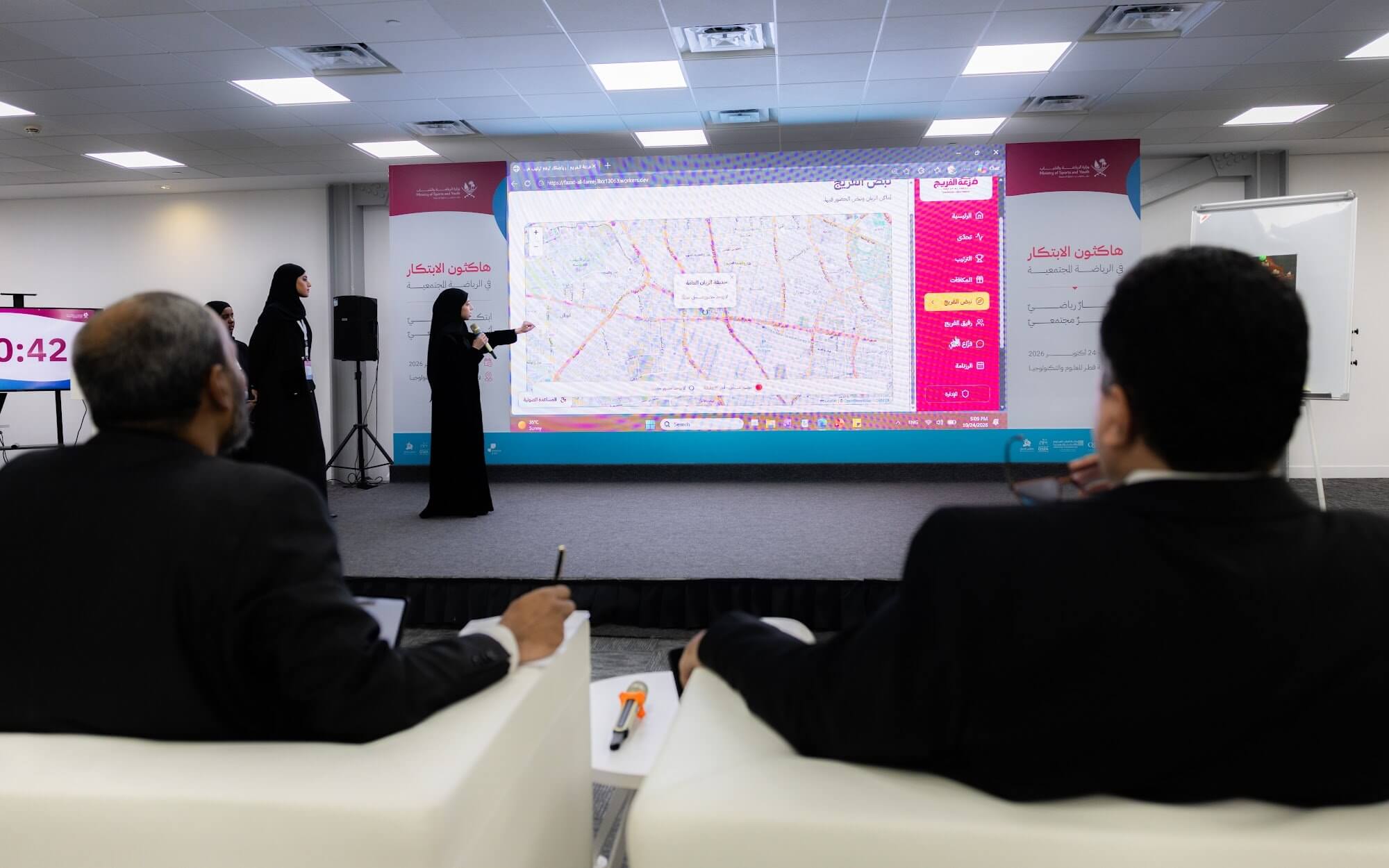
"We are delighted to have Ibtechar with us today as a partner in the Innovation Hackathon in Community Sport. Our sincere thanks to Ibtechar for their invaluable support, and to all their experts and facilitators."
A three-day capacity-building bootcamp took teams from a challenge to a pitch
Attendance at the bootcamp was a condition of entry, set by the Ministry. Nine hours ran from 15 to 17 October at Qatar Science and Technology Park, in Arabic, where most participants completed all three modules.
-
Day one: teams reduced a challenge to a single question
Teams took their challenge apart with a problem tree, built a profile of one specific beneficiary, and turned the result into a single question they could design against. They used AI tools to research and stress-test the idea under one condition, that every fact they kept carried a source they could produce. Each team handed in a card recording its challenge, its beneficiary, its chosen idea and two sourced facts.
-
Days two and three: teams learned to prototype, then to pitch
The second day focused on prototyping, with one quarter instruction and three quarters hands-on practice. Teams learned the different kinds of prototyping and how to choose and use the right method. They then tried these methods on a practice challenge, which prepared them to use the same methods on their actual solutions during the hackathon. The third day covered the pitch, structured around evidence and delivered to the room for feedback.
By the time the hackathon opened on 22 October, each team had worked through a practice challenge using prototyping methods and delivered a pitch to the room.
One set of data gave every audience the view it needed
Running a three-day hackathon is mostly an information problem. The same four questions arrive all day from every team. Where do we submit? When is the next deliverable due? What exactly are the judges scoring? Which expert is free now? Answered by hand, they occupy a facilitator who should be sitting with a team.
For the Innovation Hackathon in Community Sport 2026, Ibtechar answered those questions once, through Hackathon Pal, its AI-enabled hackathon management platform, deployed here for the first time. The platform gave participants, organisers and judges one source of truth, gave the Ministry real-time visibility, made progress transparent to every stakeholder, and cut the time lost to manual coordination. Developed in house, it ran in Arabic and English, and drove three views from a single set of data: participants, organisers, and the venue screen, with the AI assistant built into the participant view.
-
3
Views
Participants, organisers and the venue screen
-
2
Languages
Arabic and English, available before launch
-
12
Teams
Across three tracks: schools, the workplace and technology
-
9
Hours of Training
Completed before the hackathon opened
Each team had one screen, and nothing needed reconciling afterwards
Every team signed in with its own access code and saw where it stood across the four stages, what was due next with a countdown against it, and the form to submit it. Each submission link carried the team identifier already.
That detail looks minor and determined how the final day ran. Submissions arrived attached to the right team in the right format, so no one had to spend the afternoon matching files to names, and the judging panel started on time.
"Every hackathon loses hours to the same questions and to matching files to teams. We built Hackathon Pal so that work disappears, and so organisers can see every team's progress live, from the first submission to the final pitch. It can be configured for any challenge-based programme an organisation wants to run."
Ask the Pal took the repeat questions off the facilitators
The AI assistant built into the platform answered questions on deadlines, forms, challenges and judging, in either language, at any hour. A hackathon produces those questions in volume and answers them identically every time, and each one put to a facilitator is a minute taken from a team that needs help with its own problem.
It answered from the programme's published rules, so every answer matched what the organisers had set. Participants had already learned in the bootcamp's AI module that a fast answer still needs a source behind it.
The organisers could see where the cohort stood at any point
The Ministry dashboard showed every group and track in real time: on-track and overdue status, submission timeliness, a comparison across the three tracks, expert feedback, and a summary of the latest submissions on request.
This is the part that changes how a day is run. A team losing momentum appeared on the dashboard while there was still time to send someone over, rather than at submission when nothing can be done about it.
The venue screen showed progress without ranking the teams
The public view ran on the screens in the room with no sign-in required, showing cohort progress as anonymous markers moving through the stages. No group was named and no group was ranked.
Teams could see the room moving and judge their own pace against it. A public leaderboard would have changed how they worked from the first hour, and groups were left unnamed for that reason.
Facilitators stayed with the teams through both build days
Experienced facilitators and mentors from Ibtechar, joined by MSY volunteers, supported the teams on the ground through both build days. Each team also had three expert sessions coordinated by Ibtechar, one per day. Two were ten-minute consultations with specialists of the team's own choosing, including industry experts from Qatar Development Bank, Qatar Scientific Club and Ibtechar. The third, on the final morning, was an individual pitch rehearsal with one of the experts.
The Ministry formed the jury, and Ibtechar built the scoring that ran live
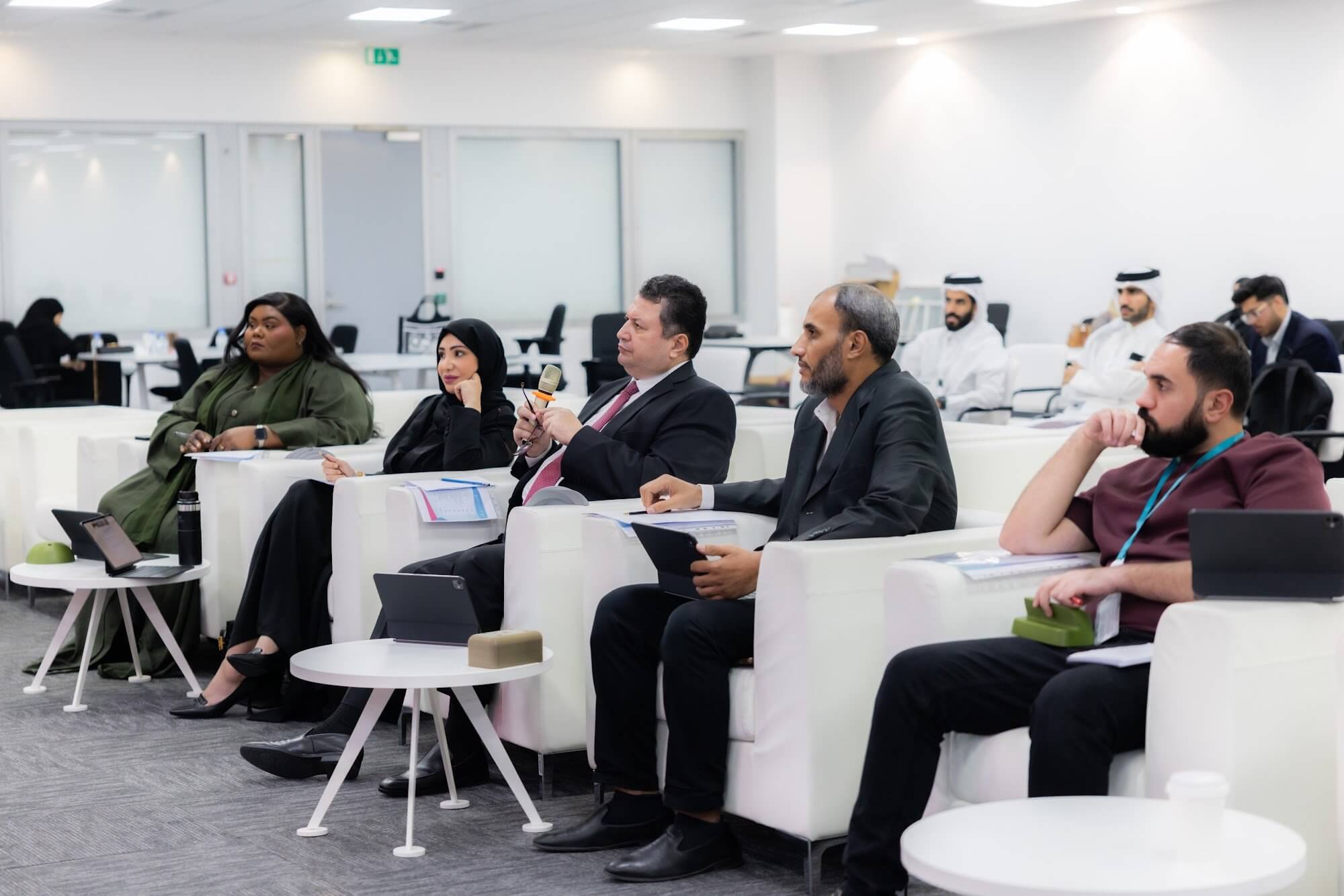
The Ministry formed the jury and published the seven weighted criteria in advance, and held four of the five jury seats, with Ibtechar holding one. Challenge fit and community impact carried the heaviest weight at 25% of the total score. Feasibility, implementation and sustainability carried 15%, which required a 90-day pilot plan from every team.
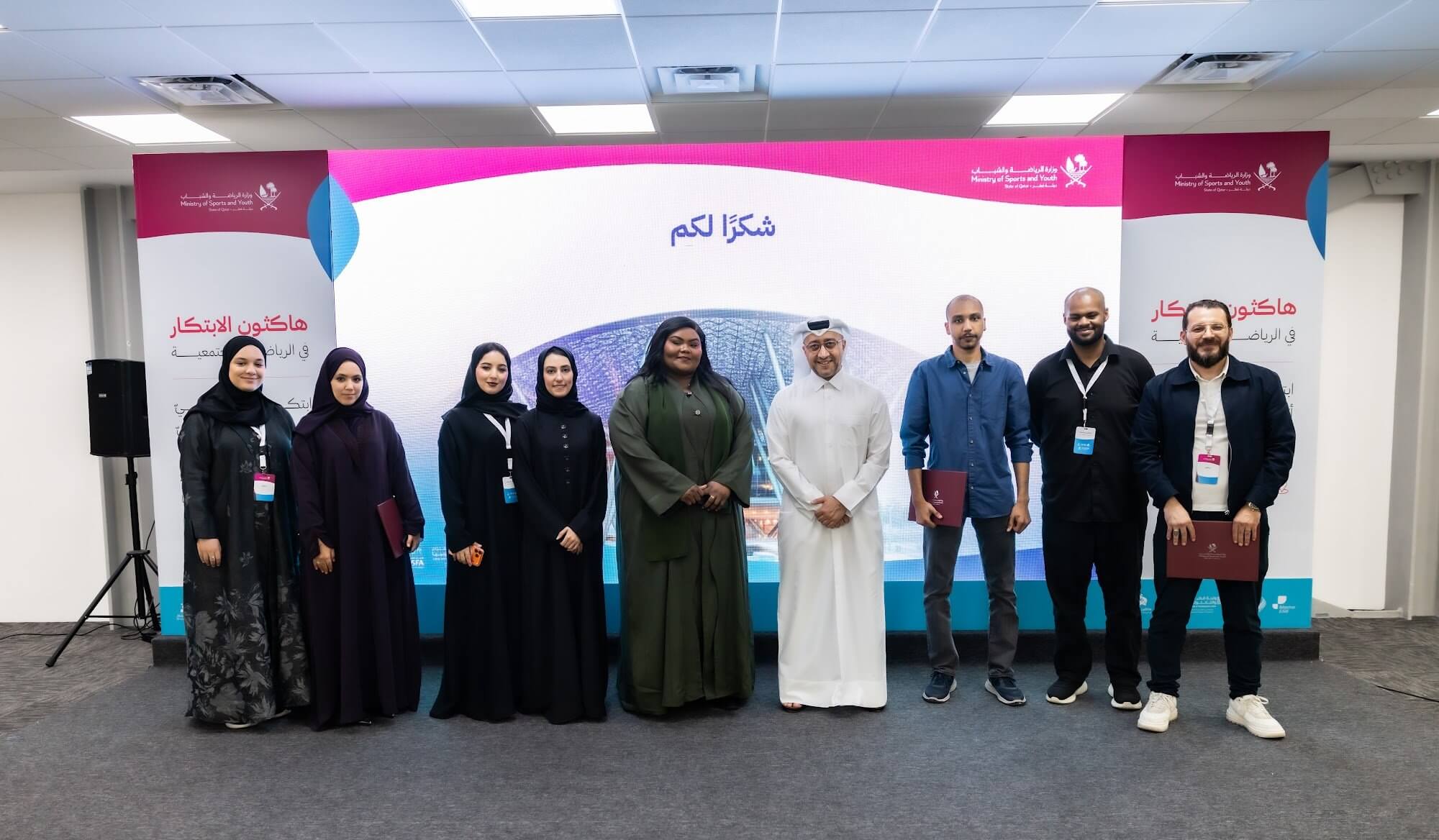
Ibtechar built the scoring interface the judges used, briefed the panel on it before the event, and ran scoring live, so results were approved and winners announced at the closing ceremony rather than days later. Three teams were honoured there, one for each track: Faza'at Al Freej in the technology track, Nabd in the workplace track, and Al Badr in the schools track.
Built once, and configured for the next programme
Almost nothing in Hackathon Pal is specific to community sport. A hackathon has the same shape every time: teams, tracks, milestones, submissions, expert sessions, scoring, and a schedule that moves on the day.
What changes between programmes is the content. Track names and challenge statements, milestone deadlines, submission forms, evaluation criteria and their weights, and the languages the room works in are all configuration.
In Ibtechar's experience delivering national programmes, this is where the work is usually lost. Tooling gets built for an event, used for 72 hours and abandoned, and the next programme starts from a blank spreadsheet.
"We at Ibtechar view hackathons as a powerful tool for capacity building. That is why the participants were trained before it began and had experts and mentors with them throughout. Using AI to run the programme itself also gave us a working model for how these technologies can serve both participants and organisers."
The platform stays in house. It is what sets Ibtechar's hackathon delivery service apart. An organisation planning a hackathon, an innovation sprint or a challenge of its own engages Ibtechar to design and deliver the full programme, from the capacity-building bootcamp to the final pitch, and Hackathon Pal is configured for it: its tracks, its deadlines, its criteria and the languages its participants work in.
Let's work together. Talk to Ibtechar about delivering your next hackathon. Contact us
Sources: MSY closing release, 26 October 2026 and the MSY hackathon page
Let's work together
Talk to Ibtechar about your next challenge or objective — and we'll guide you through each stage from the drawing board to project implementation.
